

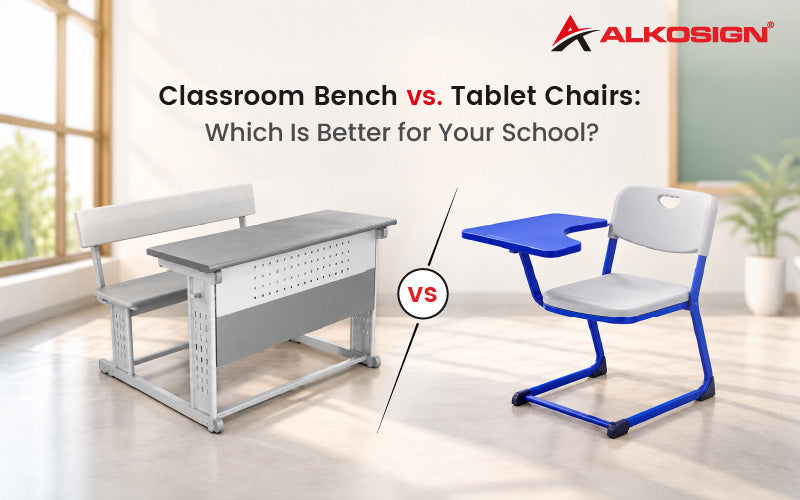
Classroom furniture shapes how students sit, write, move and organise their books. That makes the choice between a classroom bench and a bench with desk more important than it may first appear. A simple bench keeps seating straightforward, while an integrated desk gives students a defined writing surface.
The better option depends on student age, room size and everyday use.
Understanding the Basic Difference
A traditional classroom bench is primarily designed for seating. It can work well when students share tables or when a school wants a simple arrangement that leaves room for flexible activities.
The integrated format combines seating with an attached writing surface. This gives students a defined area for notebooks, textbooks and classroom work. For schools where students spend several hours writing, the additional workspace can make the furniture more practical.
A school bench supplier can offer both formats, but the decision should begin with the classroom rather than the catalogue. Student capacity, available floor area and the school desk and bench setup all matter.
Choosing Furniture for Different Age Groups
Furniture that works for older students may not suit younger children. Primary students generally need smaller furniture that corresponds to their body dimensions, while secondary students require larger seating and working surfaces.
BIS standard IS 4837 covers dimensional recommendations for school chairs and tables for children aged 5 to 17. It divides furniture into four sizes related to age groups and considers factors including knee clearance, working surface dimensions and reach.
For younger students, appropriately sized seating and desks can make writing and movement easier. Older students may need more generous working surfaces and stronger frames. A classroom bench manufacturer should therefore offer age-appropriate dimensions rather than treating every classroom alike.
Materials and Construction Matter
School furniture has to withstand daily use and repeated cleaning. Common constructions include powder-coated steel frames with laminated particle board, MDF, commercial ply or other engineered wood surfaces.
Material choice affects durability and maintenance. Steel frames can provide structural strength, while laminated surfaces can make desks easier to clean. A classroom bench manufacturer should clearly explain materials, joints, finishing and construction.
Schools buying in bulk should also consider warranty coverage, maintenance support and replacement parts.
When a Bench with Desk Makes Sense
An integrated desk provides a practical balance between seating and workspace, particularly where students spend much of the day writing.
AlkoSign's current institutional furniture range includes dual-seater benches, 3-seater benches with integrated desks and school-specific dual-seater benches. Its collection also includes laminated MDF surfaces, powder-coated steel and under-seat storage.
A classroom furniture manufacturer offering several configurations can therefore help schools match furniture to different rooms instead of using one design throughout the campus.
When a Traditional Bench May Be Better
A conventional bench can make sense when seating flexibility matters more than an attached writing surface. Schools may prefer it for activity rooms, spaces with shared tables or classrooms that need frequent rearrangement.
Without an attached desk, students may also have more freedom to turn, regroup or participate in activities. The right choice depends on what happens inside the room.
Thinking About Size, Layout and Storage
Measurements matter before a bulk order. Classrooms can have different aisle widths, teaching areas and student capacities, so one arrangement may not work everywhere.
A classroom furniture manufacturer can assess room dimensions and suggest configurations for smaller or larger sections. Schools should also consider safe movement space.
A school bench supplier may offer standard sizes as well as customised dimensions. This can help when an older building has unusual room proportions or seating needs.
Some designs also include under-seat compartments for books or personal materials. This can reduce clutter, but storage should not compromise legroom or make the furniture difficult to clean.
FAQs
1. What is the difference between a classroom bench and a bench with desk?
A classroom bench is primarily intended for seating, while the integrated format combines seating with an attached writing surface. The latter gives students a dedicated workspace for books, notebooks and classroom activities.
2. Which bench type suits primary vs. secondary school students?
Primary students generally need smaller furniture matched to their body dimensions, while secondary students require larger seating and working surfaces. Schools should select a suitable school desk and bench according to age and student measurements rather than using one size across every grade.
3. What materials do school bench manufacturers commonly use?
Steel frames, powder-coated metal, laminated MDF and plywood are commonly used in school furniture. The combination depends on the design, expected usage and required durability. The manufacturer should provide clear information about materials and construction.
4. Are benches with desks available with storage compartments?
Yes. Some designs include under-seat storage or compartments beneath the writing surface. These can be useful when students need to keep books and classroom materials close by, provided the storage does not compromise legroom.
5. What is the standard height of a school desk and bench for different age groups?
There is no single height that suits every student. BIS IS 4837 provides four furniture sizes for children aged 5 to 17 and bases them on age-related anthropometric considerations. Schools should select the appropriate size rather than use one fixed height across all grades.
6. Do bench suppliers offer bulk institutional pricing?
Many suppliers like AlkoSign provide quotations for bulk institutional requirements, with pricing depending on quantity, model, materials, customisation and delivery. A school bench supplier can discuss project-specific requirements and commercial terms before an order is placed.
7. What is the average lifespan of a classroom bench?
There is no universal lifespan because it depends on construction, materials, usage and maintenance. A classroom bench manufacturer should design frames, joints and surfaces for institutional use if long service life is expected.
8. Can school benches be customised for smaller classroom layouts?
Yes. Depending on the manufacturer, schools may be able to request different dimensions, seating configurations or storage arrangements. A classroom furniture manufacturer can help assess unusual layouts and use available floor space effectively.


Leave a comment
This site is protected by hCaptcha and the hCaptcha Privacy Policy and Terms of Service apply.